
Wassily Kandinsky, pioneer abstract artist, worked in the medium of glass painting which is interesting because…
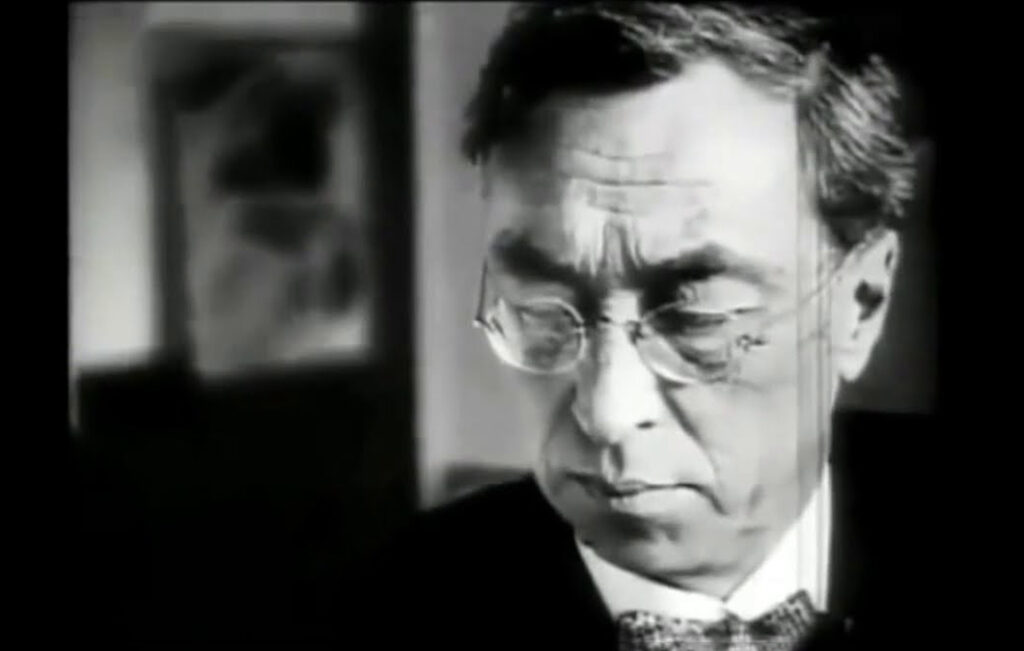
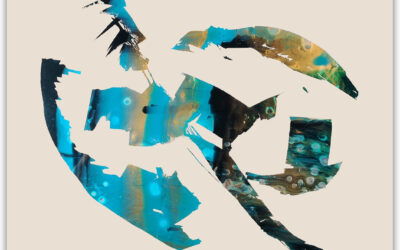
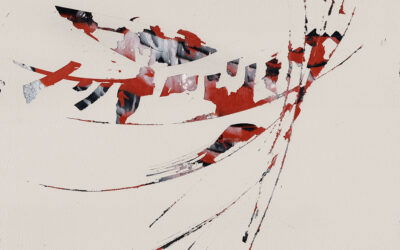
Diana and I have started to paint a series that we call Glassworx. These are reverse glass paintings, the same medium that Kandinsky was trying during the important developmental stage from 1902 to 1914. It is a technique that has been around for centuries. While researching reverse glass paintings, I found that Wassily Kandinsky, painted at least 50 reverse glass paintings.
I relate to Kandinsky in several other ways but in this posting, I want to limit myself to talking about Kandinsky in general and two of his reverse glass paintings in particular.
Kandinsky was born in 1866. His family encouraged his creative talents as a child, however, he ended up graduating in law in 1892. Then, in 1896, at the age of 30, Kandinsky gave up his promising career teaching law and economics to pursue art. Early and significant influences included Monet’s Haystacks, Wagner’s Lohengrin and the Theosophical Society. It is a much longer story to explain how these three factored into Kandinsky’s development given that he had a whole life that was very rich with influences. He was a cultural and aesthetic explorer, a gifted and wide ranging genius, art theorist, a founder, teacher and leader of art organizations and schools, a published writer and, many have said, the first abstract painter. He was more than a witness to the massive technological, cultural and national revolutions of the first half of the 20th century.
Artists experiment with materials and methods, and Kandinsky was no exception. In 1902 he met Gabriele Münter. For the next decade or so, he taught, worked with and had a relationship with Münter. At the end of the summer of 1908, Münter and Kandinsky spent a few weeks in Murnau, a small Bavarian village that they discovered on the shores of lake Staffel. Gabriele Münter purchased a house there, in 1909, and this became a place of life, conversation, and creativity. It was Munter who first discovered the local folk art of reverse glass painting. Like his contemporaries, Picasso and Kirchner, Kandinsky had an affinity for the “primitivistic” qualities of folk art. His works on glass, especially the ones of 1910 and 1911, share with the Bavarian “hinterglasmalerei” the use of bright colors, flat patterns, and an attempt at a naive mode of expression. (ref.: Rose-Carol Washton)
I need to add a note at this point. If you use Google as your main research tool, as I did, and you search for images with the search string of Kandinsky Reverse Glass Paintings, you will see many paintings from Kandinsky’s early abstract period – from about 1902 to 1914. Only a few of these will actually be reverse glass paintings. I believe that Kandinsky experimented a lot during this period and that much of the experimentation were not only testing alternative media but also ways to explore ideas which were incorporated into larger more serious pieces (typically painted on canvas). The artwork that I found with Google Image search were generally in three distinct artistic media: oil on canvas, watercolour on paper and oil on glass. It is my understanding that, while he was very fond of his glass paintings, he painted very few after 1914. There could be many reasons for this, he wanted to do larger works, glass was harder to find, he had many other concern including moving from Bavaria back to Moscow, the fragile nature of glass. These are all speculations on my part. I will say, however, that he did not develop his abstract style on glass beyond what you see here.
Wassily Kandinsky, Painting with Sun – Small Pleasures, Reverse Glass Painting, 1910, 30.6 x 40.3 cm
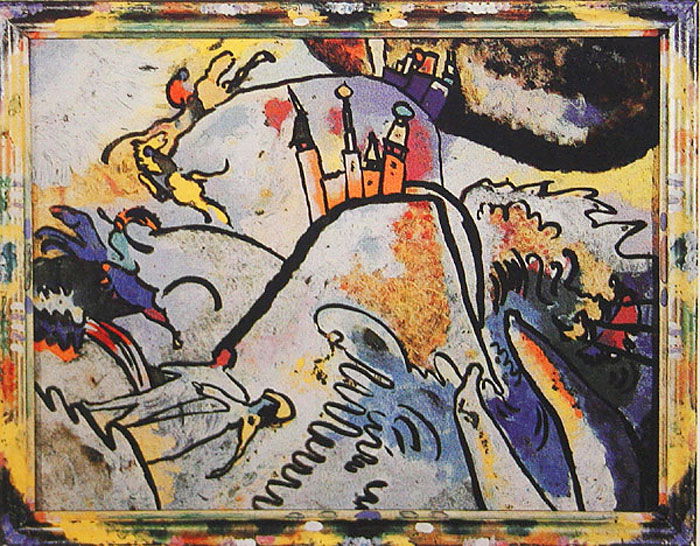
Painting with Sun -Small pleasures was painted in 1910. It is small, colourful and naive in style. The themes and visual elements contained in this painting have been repeated and explored elsewhere by Kandinsky. Most significantly on large canvases but also in many sketches and through other media. The aesthetic of the piece, partly arises from the painting technique of the Bavarian craftsmen. Münter and Kandinsky learned to apply details first and then, after backing them with flat colors, to finish with a final coating, often of silver or quicksilver.
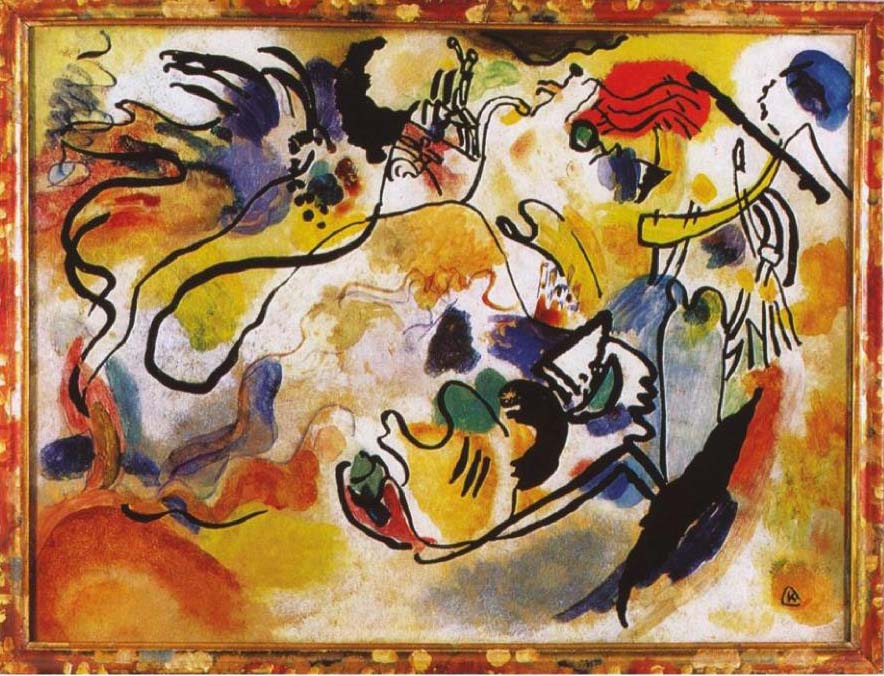
Wassily Kandinsky, Last Judgment, 1912. Glass painting, 34 x 45 cm.
This painting on glass is one of many works that included religious themes. This piece continues some of the stylistic elements of Small Pleasures.
In my view, Kandinsky’s relationship to spirituality seems to be complex and interesting. His upbringing was distinctly Russian Orthodox with, my guess, a strong dose of Russian folklore mixed in. At some point, probably related to his renewed interest in art, he learned about Theosophy. At that time, in the late 19th century and early 20th century, Theosophy was an approach to religion and science that attracted a lot of avant-garde thinkers including industrialist and inventor, Thomas Edison; artists, Hilma af Klint, Kandinsky, Piet Mondrian; poet, William Butler Yeats; and composer, Alexander Scriabin.
Kandinsky’s interest in glass painting coincides with his struggle to develop an abstract approach to painting. As a believer in an absolute, in a universal cosmic force underlying the world of appearance, Kandinsky wished to veil the external, material aspect of form. Equating abstraction with an almost messianic concept of “spirituality,” he did not feel, however, that the world was ready for paintings of pure color and form without descriptive references until late in 1913. In his autobiography, he warned that “the erasure of an object in art makes very great demands on the inner experience of the purely painterly form.” “Therefore,” he concluded, “an evolution of the observer in this direction is absolutely necessary and can in no way be avoided.” To provide a key to the spectator and to prevent meaningless decoration, Kandinsky advocated balancing abstract forms with tangible ones, “emerging unnoticed from the canvas and meant for the soul rather than the eye.” Encouraged in this development by the esthetic theories of the Symbolist dramatist Maurice Maeterlinck, Kandinsky believed that objects, like words, when stripped of their obvious connection with external reality, could be evocative without being directly associative. Most of Kandinsky’s works through 1914, including ones previously considered to be “abstract,” are based on this principle. Significantly, the glass paintings form not only a structural but an iconographic link with many of them.
– Rose-Carol Washton
Together these pieces are not a large part of Kandinsky’s work either in size or stature. He created many other works which were both much larger and more significant. These pieces are significant to us because of the use of a relatively obscure technique that we embrace and are taking further forward. In addition, while Kandinsky only painted these pieces during the period from 1902 to about 1914, they represent a solid example of his transition from art that was somewhat representative to pieces that were more abstract and not representative.
I guess I am driven to understand more about what I am doing. When Diana and I first discovered the approach we call Glassworx, we had never heard of reverse glass painting and knew nothing of the history of the technique. As far as I can tell, our approach is unique. That is interesting but not enough. I will continue to research the approach and I will talk about my research in other posts. At the same time, Diana and I will continue to explore the approach and see where the concept takes us. I am sure that we will have lots of fun along the way.

0 Comments